Leadership Lens is a series of Q&As with participants from AKFC’s Global Leadership Program. From artists to philanthropists, finance executives to medical doctors, AKFC’s Global Leaders are all dedicated to strengthening Canada’s role in addressing global and local issues, and building a more prosperous, peaceful, and pluralistic world.

Tracey Evans holds a Bachelor’s degree in International Development and Global Studies from the University of Ottawa, a Master’s degree in International Conflict Resolution and Mediation from Tel Aviv University, and a Doctorate in Education, specializing in International Educational Leadership and Policy, from the University of Toronto. In January 2021, Tracey joined Right To Play as Director of Global Partnerships, where she leads the organization’s institutional funding portfolios with Global Affairs Canada and U.S. philanthropic foundations. Learn more about Tracey on our 2025-2026 Global Leadership Program cohort page.
AKFC: Please introduce yourself — what would you like people to know about you?
Tracey Evans: Academically, I’ve always been driven by questions of equity and inclusion. My doctoral research explored the learning experiences of autistic students during COVID-19 school closures in Ontario — work that reinforced my commitment to building education systems where all learners feel seen and supported.
Professionally, I’ve worked in international development for more than a decade. My early field experiences took me to West and southern Africa, where I volunteered on HIV/AIDS and environmental conservation projects. Since 2021, I’ve been the Director of Global Partnerships at Right To Play, where I oversee relationships with Global Affairs Canada and key U.S. donors. Across all these roles, I’m driven by the belief that education is one of our most powerful tools for advancing gender equality and improving quality of life.

Outside of work, community engagement is central to who I am. I’m an avid advocate for blood and organ donation and volunteer with an organization called Shelter Movers as both a lead mover and a fundraiser — work that keeps me grounded in compassion and practical service to people rebuilding their lives.
Well-being is another priority, and yoga has become one of my favorite ways to stay connected to myself and find balance in a busy world. And when I’m not working, volunteering, or practicing yoga, you’ll usually find me adventuring with my golden retriever, Birken, who brings endless joy (and plenty of mud) into my life.
AKFC: What inspired you to pursue your career in international development?
TE: Growing up with parents who worked in the airline industry, I’ve always been fortunate to experience the world beyond my own borders from an early age, and those experiences shaped how I understood culture, community, and global interconnectedness. Being exposed to different perspectives sparked a genuine curiosity about how people live, learn, and face challenges in different parts of the world. Over time, I realized I wanted a career that would allow me not only to keep engaging globally but also to contribute in a meaningful, responsible way — international development felt like the path that aligned with both my values and my interests.
My focus on international education emerged a bit more unexpectedly. I was initially assigned an education project portfolio because of my French language skills and the regions where support was needed. But what began as a practical assignment quickly evolved
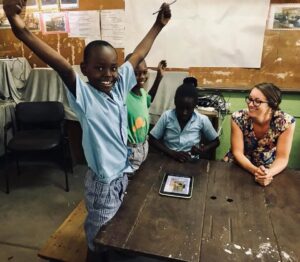
into a passion. After years of managing education programs across diverse contexts, I became deeply invested in how education can transform lives and advance equity. That’s what motivated me to return to school to pursue my Doctorate of Education in 2020 — to strengthen my real-world experience with a deeper theoretical and academic foundation, and to better understand how to build learning systems that truly serve all learners.
AKFC: Your involvement with AKFC goes a long way back. How did you first get involved with the organization?
TE: My involvement with AKFC began in 2013–2014 when I joined the International Youth Fellowship Program. I spent eight months in Bangladesh working with CARE Bangladesh on dairy value chain initiatives, supporting women dairy farmers to improve milk quality and increase their income. That experience was incredibly formative. It grounded my understanding of development work in the day-to-day realities faced by colleagues and communities — whether it’s unreliable roads, weak internet connectivity, or the competing pressures people navigate in remote settings. It’s something I carry with me even now, especially when working from Canada.
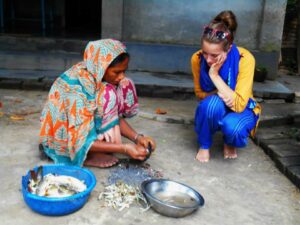
After the Fellowship, I joined AKFC’s Speakers Bureau, where I was trained to speak with Canadian audiences about the impact and importance of Canada’s international development investments. Later, from 2015 to 2020, I returned to the organization as a Project Officer and eventually as a manager, overseeing a portfolio of education programs across multiple regions.
AKFC: What inspired you to apply for the Global Leadership Program?
TE: What inspired me to apply for the Global Leadership Program was, in many ways, the absence of inspiration I’d been feeling. For those of us working in international development, 2025 has been an incredibly challenging year, and at times it has felt difficult to stay motivated or optimistic. I found myself craving the opportunity to step back, reflect, and reconnect with the bigger picture — to hear how others are navigating this complex moment, to learn from their perspectives, and to collectively imagine new approaches and solutions. I hoped the program would help me rediscover a sense of purpose and momentum.
Another key factor was my commitment to continuous professional growth. Over the past four years, I had to pause most external development opportunities while completing my doctorate full-time alongside full-time work. That period was incredibly rewarding, but it left little room for investing in my own leadership growth beyond academia. With my doctorate now complete, it felt like the right moment to re-engage, stretch myself in new ways, and dedicate time to my own learning again.
I’m also fortunate to work for an organization — Right To Play International — that genuinely values staff development and fully supported me throughout the application and participation process. Their encouragement made it possible for me to take this step, and I’m grateful for the chance to immerse myself in a program that has already helped me reconnect with why I do this work.
AKFC: What was your biggest takeaway from your time as a participant in the program? Did anything surprise you?
TE: My biggest takeaway from the program was how genuinely multidisciplinary and diverse it was — both in the speakers who facilitated our learning and, even more importantly, in the cohort of participants. The international development community in Ottawa and across Canada can feel quite small, and it’s easy to fall into familiar patterns of thinking. Spending a week with such a talented and varied group of people from completely different sectors and backgrounds was eye-opening.
What surprised me most was realizing just how many of the challenges we face in international development are mirrored in other fields. That realization made it clear that the solutions we need won’t always come from within our own sector. Engaging with such a rich cohort pushed me to step outside my usual frameworks, question long-held assumptions, and see problems — and possibilities — from new angles.
I came back to my work with fresh perspectives, expanded networks, and a renewed willingness to think creatively and look beyond traditional approaches.
AKFC: What keeps you motivated?
TE: What keeps me motivated, even in the face of constant global challenges and discouraging headlines, are the children and youth that Right To Play International works with every day. Many of them are growing up in some of the most difficult circumstances imaginable, yet their resilience, optimism, and determination to pursue their education and shape a better future never cease to inspire me. Their drive to learn, to lead, and to participate fully in our programs is a powerful reminder of why this work matters and why we have a responsibility to keep pushing forward.
One of the things I value most about Right To Play is our strong communications team, which consistently captures and shares authentic stories and videos from our programs. These pieces highlight both the work being done and, more importantly, the impact seen through the voices and experiences of young people themselves. Whenever I feel my motivation wavering, I take a moment to revisit those stories. They ground me, refocus me, and remind me exactly why I do what I do — and why stepping back or slowing down simply isn’t an option.
This interview has been edited for length and clarity.
Tracey Evans is part of the 2025-2026 cohort of AKFC’s Global Leadership Program. Learn more about the program here.