Leadership Lens is a series of Q&As with participants from AKFC’s Global Leadership Program. From artists to philanthropists, finance executives to medical doctors, AKFC’s Global Leaders are all dedicated to strengthening Canada’s role in addressing global and local issues, and building a more prosperous, peaceful, and pluralistic world.
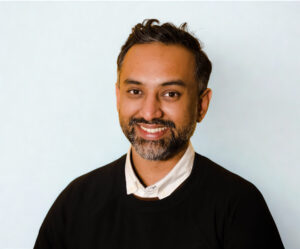
Avi Sheshachalam is the founder of Calm Growth Studio Ltd., a life sciences consultancy focused on innovation management and education. Trained as a scientist, he has worked in Canada, the Netherlands, and the UK translating research into commercial products and building global partnerships. Avi also serves as Senior Business Development Officer at MacEwan University’s School of Continuing Education, where he contributes to higher education leadership by developing corporate training and workforce programs that align industry needs with emerging skills in AI, healthcare, and professional development. Learn more about Avi on our 2025-2026 Global Leadership Program cohort page.
AKFC: What led you to pursue a career in science and innovation?
Avi Sheshachalam: I was influenced by my community, so it started very, very young. I remember third grade was when I first started thinking, “oh, this is something that I want to do” because my closest friend dropped out of school. His father — who had a chicken coop at that time — went out of business because of the bird flu pandemic, and he couldn’t afford his kids’ school fees anymore.
Over time, I started noticing that pattern with the community affected by public health crises. I’m from South India, so we have diseases a dime a dozen. My own family has been affected by disorders and diseases that are completely preventable with clean air, clean water, and clean food. I think this influenced me to think about solutions.
So, I traversed that pathway towards getting a degree in biochemistry and microbiology and biotechnology, which is the application of biology and how it can influence medical sciences. Fortunately, I was able to work on exactly those diseases that affected my community, like tuberculosis and malaria, as a post-doctoral scientist in the Netherlands.
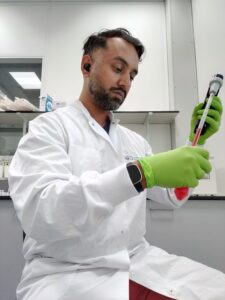
I’ve always sort of worked in the innovation and start-up space because I felt like I was responsible for addressing some of these, and I wanted to be part of the solution. But over a period of time, I realized because I worked in start-ups in the UK, in India, in the Netherlands, and in Canada — and different start-ups have different approaches to success — I started to appreciate all of these new strategies and now I teach that in school. I work as a instructor and a facilitator for the Lab to Market program that is funded by the Canadian government through their Nutrition Science Advisory Committee program.
I teach PhDs and postdocs who are just finished degrees as they come closer to commercializing their research. [I help them think about] what does it mean to build a company? What are the steps that you take from a lab to the market? So, I started in science as a response to my community, and now I’m starting to see an impact on a more global and national stage.
AKFC: What keeps you motivated?
AS: After I started teaching at the Lab to Market program, I actually stepped fully into education. Now that I work at a university in the innovation space, my [work] is directly tied to the community. I listen to the community’s requests and understand partnership needs, and how universities have this unique responsibility in supporting the growth of the city and the community that we live in… and in turn answer these big looming questions as a country that we face. In my own small way, education has become this tool that I use to address concerns on a global stage.
Also, I teach art in music to kids. And in many ways, I’m learning through them, as they connect to their culture and roots, and how music and science and art in different formats can help this feeling of belonging.
AKFC: What inspired you to apply for the Global Leadership Program?
AS: I came to Canada to do a PhD and stayed here for the past 10 years, other than my brief stint in the Netherlands for work. And when my wife joined me here, she asked if we could just call this place home and stay here for a bit. We were having dinner, and she asked a question and that really triggered a lot of changes in my life. I [thought]: if this is home, then what does it mean to be giving and taking from this community? Who am I in the context of this space? If I’m home, what exactly am I offering to my other community members in this place? I think that’s what inspired me in many ways.
AKFC: Do you have any questions or curiosities you are excited to explore over the course of the program?
AS: What I’m hoping to learn with the other participants is how they show up as leaders in their communities. I think learning from others is an important part of this program.
I’ve been reading [some of the] content for Global Leadership Program in advance of being in Ottawa, and I’m starting to sense that we are all talking about the same topics, using
different vocabulary. I think this single space will put all of us onto the same page, so that we have the same vocabulary to converse and that we also are able to resonate with each other.
AKFC: Is there anything else you’d like to add?
AS: I’m coming with a listening ear, so I’m hoping that I absorb as much as I can!
This interview has been edited for length and clarity
Avi Sheshachalam is part of the 2025-2026 cohort of AKFC’s Global Leadership Program. Learn more about the program here.