Kayla Mudaliar is currently working as a Partnership Fellow as part of AKFC’s International Youth Fellowship. Read her Dispatch from Bishkek, Kyrgyz Republic, to learn more about this experience.
 The development sector is the most unpredictable and turbulent it’s ever been since the end of the Cold War.
Young professionals, like myself, and long-time practitioners are watching, learning and adapting together, in real time. That is unsettling. I have never disliked and loved this sector more than I do right now.
This is my third international development contract and third country I have moved to for work. Very early on, I learned that to successfully work in development, you cannot have “rose-colored glasses,” you have to find just the right amount of cynicism mixed with altruism; a realistic ideal. As the sector is being squeezed and hung out to dry, in addition to global, regional, and state politics drastically shifting towards nationalistic policies, this ‘realistic ideal’ becomes more difficult to pinpoint and hold on to. However, seeing the communities and meeting the people that AKF Kyrgyz Republic, AKFC, and Global Affairs Canada support carries a new weight and kind of hope that resonates deeper than it ever has.

With my work at the AKF Kyrgyz Republic Partnerships team, I have had the opportunity to work on a multitude of assignments and travel to different oblasts (similar to provinces in Canada) for field visits. One of my favourite parts has been reviewing program reports for submission and then being able to engage with these programs in-person, allowing me to meet people and see equipment directly related to it.
An example of this holistic engagement was my journey in November 2025 to Kerben Town in Jalalabad for the Foundations for Health and Empowerment (F4HE) program. A few weeks prior to this trip, I edited and reviewed the F4HE report which would be sent to the donor unit. The report included a section on the creation of an Early Childhood Education (ECD) room for the children’s unit and the purchase order for toys and books. I remember reading this section and thinking, “Wait… the children’s unit does not have a play area or toys until now? It must be a very small hospital.”
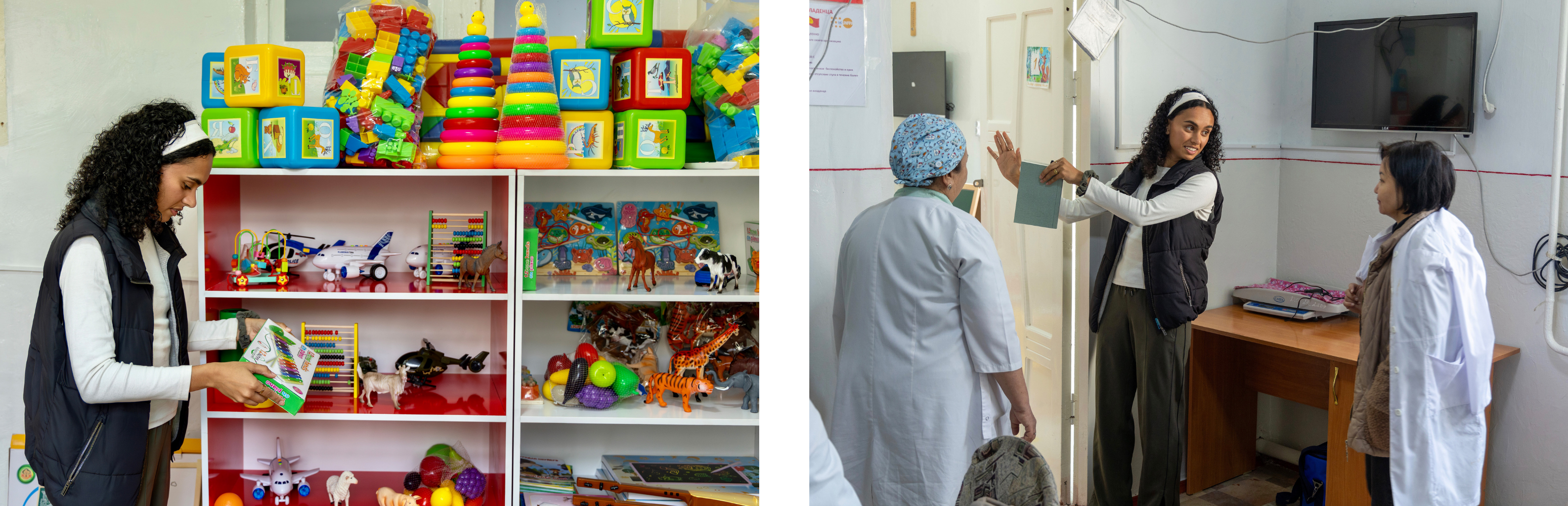
Upon arrival at Ak-sy District Hospital, I realized I was mistaken. Ak-sy District was a multi-unit, multi-building hospital with staff and patients everywhere. On my second day there, local AKF staff informed me that they were bringing in the final toys for the ECD room. I asked if I would be allowed to visit the ECD room and children’s unit. I was still surprised that the hospital did not have an ECD room prior, a building with no stimulation for the age demographic that needs it most. This unit is for children who require intensive care or treatment or who are too sick to leave the hospital and need 24-hour care.
The staff escorted me to the ECD room — which had only been established one week prior — where mothers and their children were fully immersed and engaged. The children were playing with toy instruments and toy animals, while mothers were reading books (which were provided in both Kyrgyz and Russian for cultural relevance) to young children. My first thought upon entering the ECD room was how grateful I was to be allowed into such a sensitive space as an outsider, while my second thought was “I just read and wrote about this, and am witnessing the impact.”
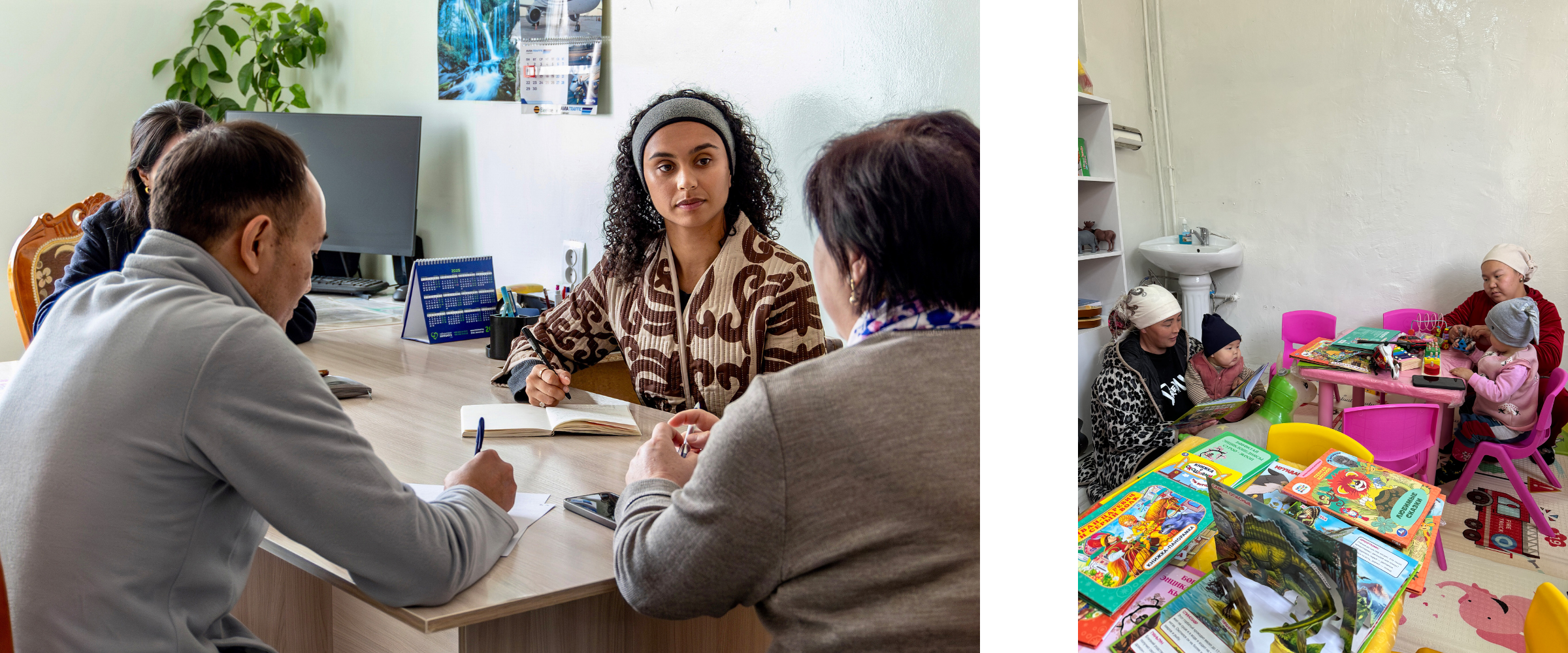
This work trip also included visits to other oblasts and towns with F4HE components, and each participant had a story to share.
In Naryn, we met Gulzat — a doctor who is informing her community on best health practices and provides quality services for early detection cancer screening in her community. In addition to visiting her clinic, Gulzat also let us into her home for a traditional Kyrgyz feast, to meet her family and sing traditional Kyrgyz songs.
In Ak-muz village in Naryn, we met Bayish — a community leader who is passionate about breaking traditional and generational gender roles within families. By creating learning spaces that mimic healthy father-son relationships, Bayish opens up conversations with young men about what it means to be a good father.
On the last leg of site visits in Kerben Town, Jalalabad, we met Gulmira, an expecting mother attending healthy pregnancy and delivery classes. During an interview, she told us what it is like to take care of the house, her two kids, and two nephews independently. The smile on her face was a testament to her resilience and her hope that, in the future, her community and children will have more knowledge and better access to healthcare as a result of the services she was able to access through the F4HE project.
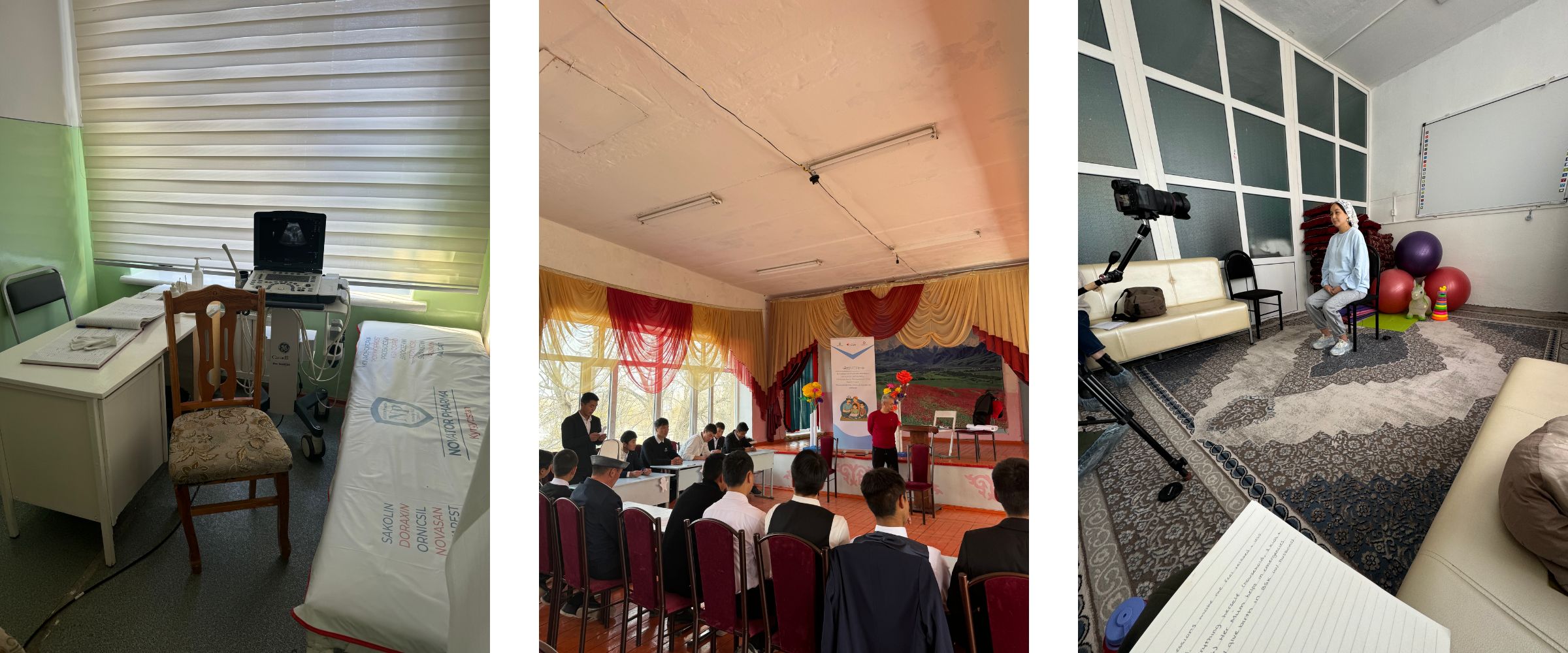
In seeing reports come to life and communities adopt them as their own, I am reminded that international support is still making a huge difference, but it is now modelled in different ways. My narrative has shifted: international development isn’t fully hung out dry; it’s simply asking us to engage more honestly. So, while I can still accept the sector is as fragmented as it’s ever been, my role in Partnerships has allowed me to rediscover my ‘realistic ideal’ and reflect on how development will continue to flourish in small rooms where change is already taking root.
Since 1989, almost 600 recent graduates and young professionals like Kayla have participated in AKFC’s International Youth Fellowship. Learn more about the program.