From Yukon to Newfoundland and Labrador, global citizenship education is breaking new ground across the country
By Jacky Habib
Every Wednesday when the bell rings to signal the lunch break at FH Collins Secondary School in Whitehorse, two dozen students shuffle into a classroom. They don’t have a lot of time, but they’re determined to make the most of it, taking bites of their food between conversations.
On the agenda this week are a range of action items rallying the group in support of local and global issues. One student makes a pitch about how their peers can take action to protect Canadian wildlife; another student provides an update on a fundraiser in support of Ukrainians impacted by the war.
These lunchtime gatherings — filled with conversations on global issues, advocacy and social action — are a regular occurrence at the high school’s social justice club. The club has become a dynamic space for students wanting to make a difference in their community and beyond. Their guide is Meera Sarin, an educator of almost 20 years who teaches Social Justice, Spanish and Social Studies at F.H. Collins.
“I knew that was the way I was going to connect with young people,” says Sarin. “Some people coach sports, some do drama clubs — and for me it was always going to be through social justice.”
Sarin’s introduction to social justice began in the small town of Dauphin, Man., where she was raised by immigrant parents from India and England. Their social values anchored their family in community.
Sarin’s mother, Elizabeth, a public health nurse and feminist leader, spent much of her time on First Nations reserves — often with young Meera in tow — providing immunizations and conducting home visits for new mothers.
In return, community members would gift her with tokens of appreciation. Sometimes it was fish, at other times it was moccasins. Each time, it was a gesture of gratitude, and one that illustrated reciprocity.
“I always say my mom was so ahead of her time because she really learned so much from the Indigenous people,” Sarin reflects.
Today, her son Aleix Toews carries that same passion. Throughout high school, Toews was an active member of the social justice club at F.H. Collins, “dragging” his friends along to the weekly lunch meetings — proud that his mother was at the helm of it all. Many of his fondest high school memories revolve around the social justice club, which encouraged him to take action both big and small, he says.
Toews and other students had often noticed discarded fishing lines around their community, which posed danger to wildlife. The students had an idea for a simple fix and approached the Yukon Fish and Wildlife Enhancement Trust with a pitch. Their boldness was rewarded with funding to put their idea into action, and the next several months were spent organizing a community clean-up day along the Yukon River. They also built fishing line receptacles, which they installed at various fishing spots in Whitehorse so people could responsibly dispose of their discarded lines.
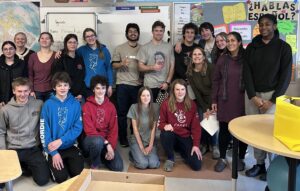
The project was a huge success. Students connected with local groups on the issue, including the Kwanlin Dün First Nation and Yukon Conservation Society, and raised awareness about the harms of discarded fishing gear and were even featured in local and national media. Toews says his involvement in the social justice club was a confidence booster.
Now a university student studying bioresource engineering at McGill University, Toews reflects on how his upbringing shaped his social consciousness. Growing up, he read diverse books and helped his parents cook dishes from around the world for their family dinners.
When he was eight, his parents took sabbaticals and the family of five embarked on a year-long trip around the world. From Bosnia to Türkiye to India, they traveled to experience culture, understand history, and engage with social issues globally.
“All of those experiences have stuck with me throughout my life and have impacted how I see the world and what my interests are,” Toews says.
While he was a student at F.H. Collins, the school joined the UNESCO Associated Schools Network, connecting with thousands of schools worldwide that all promote innovative, inclusive and sustainable education. The school committed to doing its part to address how the United Nations’ 17 Sustainable Development Goals (SDGs) aim to secure peace and prosperity for all people and the planet.
“I think it elevates the consciousness of our school and our ability to be part of a global community [and] a Canadian community that values global work and values our relationships with people outside of our territory,” Sarin says.
As part of their efforts toward achieving the SDGs, students participate in Whitehorse Connects, a food drive organized by the Yukon Anti- Poverty Coalition. With more than one in every six households in the Yukon facing food insecurity, according to Food Banks Canada, the event is one that hits close to home for many students.
At the food drive — which happens multiple times annually and has become the school’s most popular event — students take turns cooking and serving food to community members, who can also access free services like haircuts and portrait photography.
Toews smiles, remembering how he and his friend Curtis would always be assigned to help in the “dish pit,” washing dishes all day. It didn’t matter to them; the events were core memories of their high school years.
For Sarin, seeing the satisfaction on students’ faces when volunteering is a highlight. “It really lights these students up when they know that they’re doing something helpful,” she says. “It’s not token volunteering. They’re working really hard [and] making connections. They meet health nurses, politicians and other people offering services. As much as it is helpful for people living on the margins, it’s just as helpful for our students to see how a community can come together.”
And it makes a lasting impression. Sarin has heard about students who, after understanding the impact of the food bank in their community, have gone on to volunteer there on their own, even years later.
Sarin’s approach to engaging students in social issues involves “a little bit of local work, a little bit of global work” and, of course, an educational component in the classroom. Over the years, Sarin has consciously curated educational resources for her students. At the top of her list is the Inspiring Global Citizens toolkit. The four-part toolkit, which incorporates a range of resources including lesson plans, activities, discussion guides and handouts, encourages learners to think critically while linking local issues to global issues.
Sarin credits the guide, which was developed by Aga Khan Foundation Canada, for helping her students navigate global citizenship.
Laboni Islam, an education consultant who helped shape and write the toolkit, says it was created to support students in identifying their unique gifts and capacities and channeling them to effect change. It was reviewed by educators across the country so that it would be rich in diverse perspectives.
“It was important to engage educators with varied points of view, geographies, and relationships to the material and ask: What’s working? What can be done differently? What opportunities do you see? Their collective feedback was invaluable and integrated into the toolkit,” says Islam.
Sarin hopes that lessons on world issues and social justice spark a lifelong journey of global citizenship for young learners.
“Global education stirs something in these students,” she says. “When they realize that they’re a part of something so much bigger than what’s happening in their school or their community, it motivates them. It encourages them and it gives them hope — and I think we all need a little bit more hope.”
ON JAN. 17, 2020, heavy snow billowed down on the province of Newfoundland and Labrador.
The wind was unrelentingly cold, with temperatures reaching below -20 C. Residents hunkered down at home as they watched the blizzard from their windows — a sea of white piling up on the streets.
Jackie Rockett, a high school social studies teacher and librarian at O’Donel High School in Mount Pearl recalls that week in vivid detail.
“I think we were in our houses three or four days before we could get out with all the snow. The snow was well above my husband’s truck — it was just completely buried.”
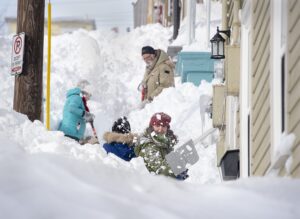
The blizzard, which was dubbed “Snowmageddon,” had brought much of the tiny province to a halt when nearly 93 centimetres of snow fell on that January day. Highways were closed, boats stopped operating, and grocery store shelves were empty as shipments of goods coming onto the island were halted.
For Rockett, the blizzard was an opportunity to engage her students in learning how a singular event can cause a domino effect with wide- ranging and sometimes catastrophic consequences.
“That [event] always sticks in our students’ minds as a starting point when we talk about food insecurities, access to food, and access to clean water,” Rockett shares.
Before teaching high school students, Rockett taught English as a Second Language (ESL) to newcomers. Working closely with recent immigrants and refugees ignited her passion for global citizenship and became a foundation for the teaching work she does today.
“When you’re [teaching], there’s so many opportunities to bring in global issues with your reading selections, your short stories — it’s always been part of my teaching, whether it’s been Social Studies or English,” Rockett says.
Rockett focuses heavily on teaching the SDGs to her students; she believes the goals are a catalyst in helping them become global citizens. Four years ago, she began implementing a final project where students create an action plan around an SDG of their choice and enact it in their community. Students’ past projects include creating awareness campaigns for mental health resources and developing an education plan for elementary schools on the importance of recycling.
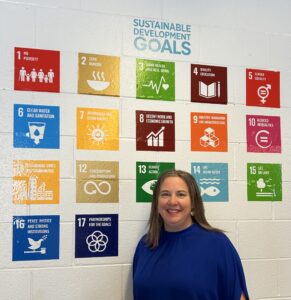
Like Meera Sarin in Whitehorse, one of Rockett’s go-to resources when teaching about the SDGs is the Inspiring Global Citizens toolkit, which she helped review during its development.
“What I love about it the most is that it makes the students have personal connections [with the SDGs, by prompting]: how do you feel when you look at this? What is something that you feel you could do?” says Rockett. “Once they start to get that personal connection, then the empathy piece comes in.”
Within the toolkit, one of her favourite resources is the Gapminder, which provides students with a visual representation of global economic disparity. She says these modules, when paired with classroom discussions, play a large role in educating students on global inequalities and encouraging them to take action.
“There are so many different ways of practicing being a global citizen. I think it’s one of our key roles [as educators] to encourage all of those different steps which are a part of their journey,” Rockett says.
Hunter Richardson, who graduated from O’Donel High School in 2018, says the globally minded curriculum and accompanying classroom conversations paved the way for the social justice work she has done ever since.
“My passion for community really began with our Ethics class, so I can credit Ms. Rockett with my current trajectory,” says Richardson, now a social worker at a local women’s centre. Without a doubt, she says, Rockett was the teacher who impacted her the most.
Richardson often remembers being moved when she came across the story of Jacob Thompson, a nine-year-old from Portland, Maine, who was hospitalized around the holidays with terminal cancer.
He wanted to celebrate Christmas early, and his family had requested that people from around the world mail him holiday cards. Richardson had an idea: what if students at O’Donel could participate? Rockett wholeheartedly embraced the idea, rallying students for a card-making session so they could help make the boy’s last Christmas as special as it possibly could be.
It worked. Thompson’s parents said the boy received 400,000 holiday cards in the mail from people around the world, bringing immense joy in his final days.
“That project meant so much to me because I actually got to see how people will come together to support one another, even if that person is across the world,” Richardson reflects. “There may be a lot of pain in the world — especially lately — but there is also a lot of good.”
Rockett is hopeful that her classroom lessons can inspire students to be part of that good. She says students want to have difficult conversations about society and the world at large, and that educators can have a role in helping them navigate these questions and explore their role as changemakers.
“I really do feel that they are the generation that will start making bigger change,” she says.
Rockett doesn’t have to look far to realize that her hope is already a reality. With many of her former students, like Richardson, working to make a difference in their community on a daily basis, “bigger change” is within reach.
Access the Inspiring Global Citizens toolkit here.
This article was originally published in Global Citizens 2026, a special issue of Canadian Geographic magazine that explores how youth, educators, and communities are engaging with global challenges and opportunities in an increasingly interconnected world.